What Controls Should We Have in Place Before Letting an AI Agent Access Our Email, CRM, or Financial Systems?
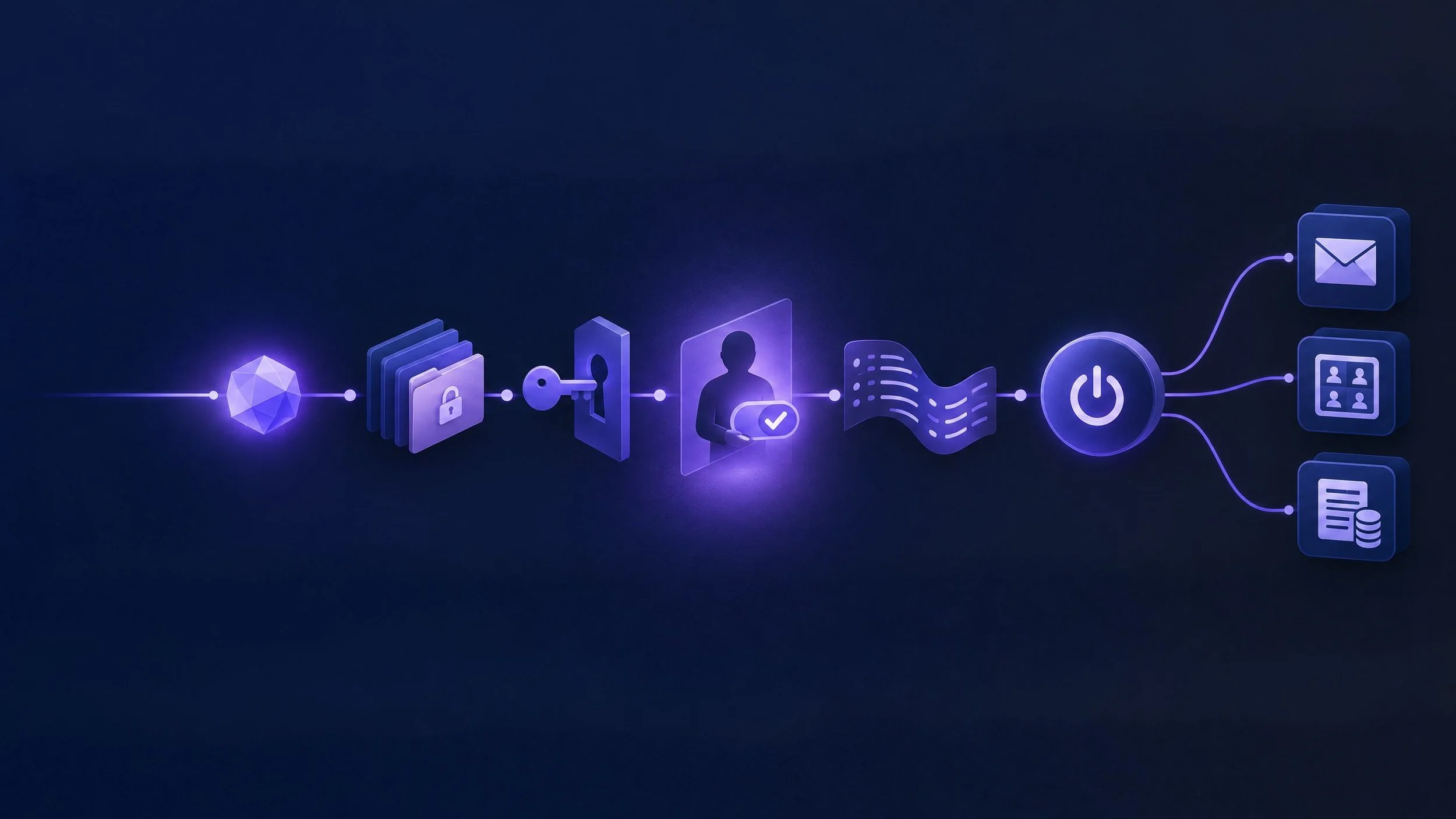
Five controls belong in place before an AI agent gets credentials to email, CRM or finance: a data classification that marks what the agent may touch, access scoped to that classification, a human approval step for any action that sends, pays, deletes or changes a record, a log of everything the agent does, and a tested way to shut it off. AI Transformation Framework (AITF) builds the foundation for the first two into every client's governance work through a data classification and a tool permission matrix, both completed in the first three months of the engagement.
An agent is the first AI tool in most companies that acts on its own, so the decision to hand one a login belongs with the executive team.
How is an AI agent different from the AI tools employees already use?
An agent takes actions. A chat assistant drafts an email for a person to read and send; an agent sends it, updates the CRM record and moves the invoice to the next step. That shift moves the risk from what an employee types into a tool to what the tool does with the access it holds.
The question is reaching mid-market companies now. McKinsey's State of AI in 2026, published in August 2026 and drawn from 1,719 respondents across 97 nations, found that 22 percent of respondents at smaller organizations report scaling AI agents, alongside 40 percent at organizations above $1 billion in revenue.
What controls belong in place before an AI agent gets access?
Each of these controls needs a named owner before the agent connects:
A data classification the agent is held to. The company names its categories of data and sets a rule for each, so the agent's reach follows a written standard.
Access scoped to the job. The agent gets its own credentials and the narrowest permissions the task requires, read-only wherever the task allows.
Human approval for consequential actions. Sending to a client, moving money, deleting records and changing customer data wait for a named person to approve.
A complete activity log. Every action the agent takes is recorded somewhere a person reviews on a set schedule.
A tested shutdown. A named person can revoke the agent's access within minutes, and the team has practiced doing it.
How much autonomy should an AI agent get at the start?
Start with the least it needs, and raise it in steps as the agent earns trust.
Gartner's May 2026 guidance on AI agent governance recommends governing agents in proportion to their autonomy across four levels: Observe, with read-only access; Advise, where a human reviews its recommendations; Act with Approval; and Act Autonomously. In the same release, Gartner predicted that by 2027, 40 percent of enterprises will demote or decommission autonomous AI agents because of governance gaps identified only after production incidents.
Gartner also warns that over-restricting simple agents slows delivery and drives shadow development. The practical answer for a mid-market company is to start any agent touching finance or client communication at Observe or Advise, then move it up one level at a time, with evidence from the activity log supporting each step.
Which data should an AI agent never reach?
An agent should stay out of the most sensitive tier of company data, the same tier a governance policy keeps away from every AI tool.
The Four Pillars of AI Governance are AITF's framework for governing how a company uses AI: Classify Your Data, Realistic Policies, Amnesty and Transparency, and Streamlined Access.
The first pillar defines three to five data buckets so the rules are precise. In AITF's example classification, the Restricted tier covers trade secrets, personally identifiable information and regulated data, and no AI tools are permitted there. An agent inherits those rules the moment it connects.
The second pillar ties each bucket to specific rules through a Tool Permission Matrix, which maps each approved AI tool to the data it may handle. Connecting an agent means adding a row to that matrix, with its own permissions and its own owner.
How should a company review a request to connect an AI agent?
Review it through the same process used for any new AI tool, with extra weight on two questions.
AITF's fourth pillar, Streamlined Access, gives employees a fast path to request tools and runs every request through a five-point vetting checklist: data handling, vendor security, compliance, access scope and rollback plan. For an agent, access scope and rollback plan carry the most weight, because they settle what the agent can touch and how quickly the company can take that access back. The questions to put to the vendor are the same ones covered in what to ask an AI vendor before you sign.
The same pillar sets a service-level commitment for answering requests. That commitment matters more with agents, since a slow review is what pushes a department to connect one on its own.
What does the evidence say about access controls on AI today?
Most organizations are still putting these controls in place. IBM's 2026 Cost of a Data Breach Report, conducted by the Ponemon Institute and published in July 2026, found that 40 percent of organizations applied access controls to AI models and data, and that 92 percent of organizations with an AI-related breach lacked proper AI access controls. The same report found that 68 percent of breached organizations lacked policies to manage AI or detect shadow AI.
The access decision is where the exposure begins, which makes it the right place for executive attention.
Who should own the decision to give an AI agent access?
A named executive owns the AI program, and a process owner signs off for each system the agent touches. The process owner knows what a bad day looks like inside the CRM or the ledger, and the program owner keeps the whole policy consistent.
AITF asks every client for a program owner and a process owner before governance work starts, and the AITF program names an owner for each barrier the readiness work surfaces. The same structure carries an agent decision: one person approves the access and one person answers for what the agent does with it.
What else do leaders ask about AI agent access?
-
A data classification, access scoped to the task, human approval for consequential actions, a complete activity log and a tested shutdown, each with a named owner.
-
Yes. Separate credentials keep the agent's activity distinct from any employee's and let the company revoke its access without affecting anyone else.
-
Start agents touching finance or client communication at read-only or advisory access, and raise autonomy one level at a time as the activity log shows the agent performing as intended.
More answers on AI governance sit on the AITF FAQ page. If your team is fielding agent requests and the rules underneath them are still taking shape, book a short call with me to see whether AITF fits.
Delcie Bean is the founder of AI Transformation Framework and CEO of Buildkin and Paragus IT. He built Paragus IT from a company he founded at fourteen into a 100 percent employee-owned IT firm headquartered in Hadley, Massachusetts. With AITF clients, he sets the standard for what a governed AI program looks like and holds leadership teams to the decisions they make. Meet Delcie and the AITF coaches.